The First Charter of Virginia, 10 April 1606
Full text of the charter.
Open the sourceLondon and the founding of Jamestown, 1606–24
Jamestown is usually told from Virginia. Seen from London it was a joint-stock venture sold to City investors, and this site argues that the Company’s money problems shaped what Virginia became, including the arrival of the first Africans in 1619.
James I issued the First Charter on 10 April 1606. It created two companies, one of London and one of Plymouth, to settle the North American coast. The London company raised money from merchants and gentlemen who hoped for a return, and that fact explains most of what follows.
The charter is short and easy to quote. Alongside it, Susan Kingsbury’s edition of the Company’s own records shows what the investors argued about once the money started to run short.
Full text of the charter.
Open the sourceDigitised volumes of the Company’s court books and letters, including volume three.
Open the sourceThe settlers left from Blackwall on 19 December 1606 in three ships, the Susan Constant, the Godspeed and the Discovery, under Christopher Newport. A monument at Virginia Quay marks the 105 who sailed. Jamestown itself was founded in May 1607.
The archaeology at James Fort, under way since 1994, gives us objects from tightly dated early layers and is a good way to bring a physical source into the exhibit.
Official record of the Blackwall memorial.
Open the sourceThe archaeology project and its published papers.
Open the sourceKeeping the money coming meant advertising. Nova Britannia (1609) was one promotional tract. A broadside advertised the lottery that the Company ran in 1615. By 1612, according to the Encyclopedia Virginia, the Company had already dropped the joint-stock model in favour of lotteries. Sir Thomas Smythe, treasurer from 1609, was ousted by Sir Edwin Sandys in 1619.
A promotional pamphlet aimed at investors and settlers.
Open the sourceA London-printed advertisement for the Company’s lottery.
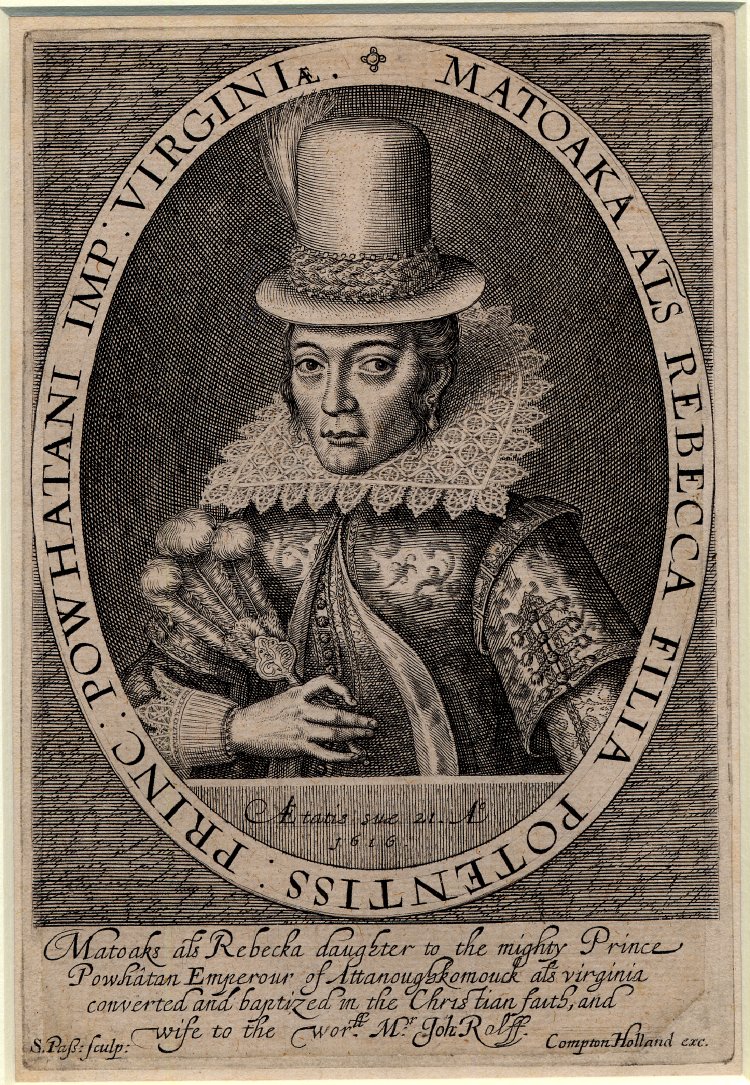
Open the sourcePocahontas came to England in 1616 and died at Gravesend in 1617. Simon van de Passe’s engraving of her dates from 1616. In late August 1619 the first documented Africans reached Point Comfort aboard the White Lion and the Treasurer. The Treasurer was owned jointly by the Earl of Warwick and Samuel Argall. The Crown revoked the charter in 1624.
The engraving shown above, held at the British Museum.
Open the sourceShort scholarly entry on the 1619 arrival and the ships involved.
Open the sourceA chartered company running a territory for profit is not a seventeenth-century curiosity. It comes back whenever people argue about corporate power and empire. The 1619 landing is also at the centre of current memory politics in the United States, and Queen Elizabeth II visited Historic Jamestowne on 4 May 2007 during the 400th anniversary.
Pocahontas by Simon van de Passe 1616.jpg, Wikimedia Commons (https://commons.wikimedia.org/wiki/File:Pocahontas_by_Simon_van_de_Passe_1616.jpg). Engraving by Simon van de Passe, 1616. Licence on the Commons page: public domain.
